


Journal
Aristotle’s View of Nature: Order, Change, and Purpose

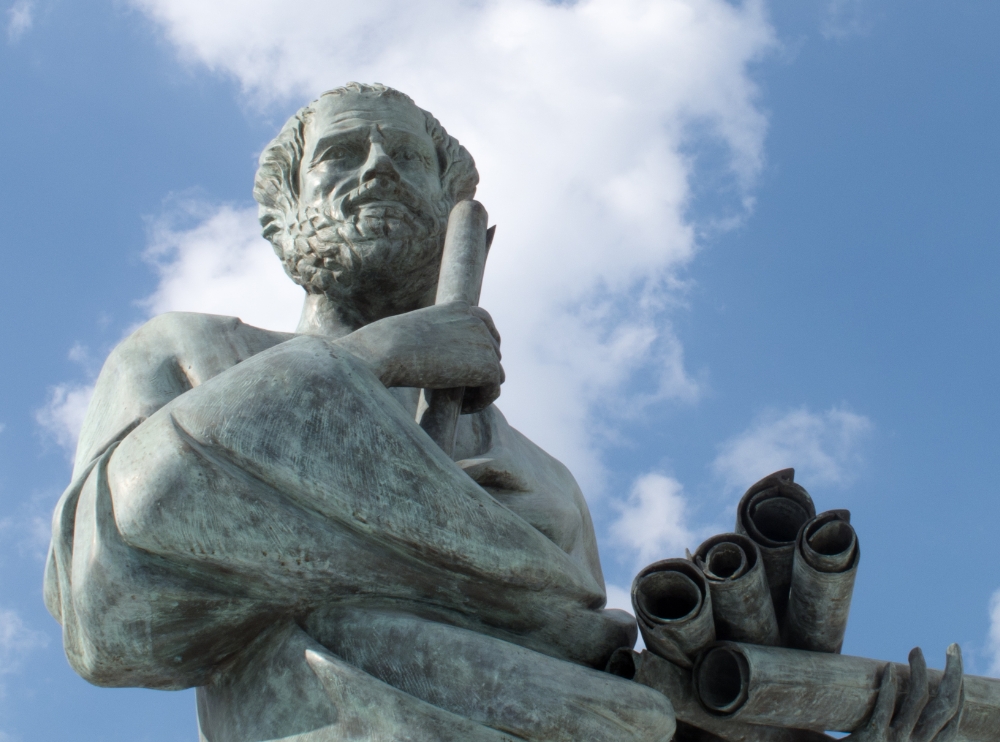
Aristotle did not study nature as a distant observer collecting random facts. He studied it as someone trying to understand how the world works as a whole. For him, nature was not chaos. It was structured, intelligible, and full of patterns that could be discovered through careful reasoning and observation. This belief shaped not only his own work, but also the way later civilizations approached science, philosophy, and the search for knowledge.
When Aristotle wrote about the natural world, he was not only describing what things look like. He was asking deeper questions. Why do things move? Why do they change? Why does one process lead to another? What makes an object become what it becomes? These questions appear throughout key works such as Physics, On the Heavens, and On Generation and Corruption. Together, they form one of the most ambitious attempts in history to explain nature through a unified framework.
Although modern science no longer follows many of Aristotle’s specific conclusions, his overall method still feels remarkably relevant. He wanted to understand not just the surface of nature, but its structure and logic. He believed nature was full of purpose, and that change was not random. Instead, change followed principles that the mind could grasp. That is why Aristotle’s natural philosophy remained influential for centuries. It offered not only explanations, but a way of thinking about reality itself.
Nature as Order, Not Accident
Aristotle viewed nature as something inherently ordered. This does not mean he thought everything was perfect or simple, but he believed that natural processes follow patterns that can be understood. For him, nature had regularity and direction. Events in the world were not simply the result of blind coincidence. They were connected to what things are and what they are meant to become.
This is one reason Aristotle was committed to studying nature through systematic inquiry. He did not want myths or vague storytelling. He wanted explanations that were stable, logical, and based on experience. In Physics, he approaches nature by asking what it means for something to be natural in the first place. A natural thing, for Aristotle, has an internal source of movement and change. A plant grows because it contains within it the principle of growth. A stone falls because its motion expresses a natural tendency.
This focus on internal principles is central to his worldview. He thought that in order to understand nature, you must understand the kind of thing you are observing. You cannot separate behavior from essence. The nature of the object explains the type of change it undergoes.
This can feel unfamiliar today because modern science often focuses on external forces and measurable interactions. Yet Aristotle’s emphasis on order has a lasting impact. He treats nature as something understandable, something that can be studied with confidence that it will not collapse into randomness. That is part of what made scientific thinking possible. The belief that the world has patterns is the starting point of every science, even if the details of Aristotle’s explanations no longer stand.
Motion and Change in Physics
Aristotle’s Physics is not a physics textbook in the modern sense. It is a philosophical exploration of movement, change, time, and causality. For Aristotle, motion is not only what happens when an object moves through space. Motion includes any kind of change, such as growth, decay, heating, cooling, or transformation. Nature is full of motion because nature is full of processes.
A key idea in his analysis is that change is always a movement from potentiality to actuality. Something becomes what it has the capacity to become. A seed becomes a tree. A child becomes an adult. Water becomes steam. Aristotle believed the world is defined by this movement from what could be to what is.
This concept allowed him to explain change as meaningful rather than chaotic. A thing does not become anything at random. It becomes what its nature allows. This gives change a kind of structure. It turns the world into a space where development follows intelligible paths.
Another crucial part of his explanation is his theory of causes. Aristotle argued that to truly understand a natural event, you must understand it in more than one way. You must know what something is made of, what form it has, what produces the change, and what the purpose of the change is. These four causes are not just a technical framework. They reflect Aristotle’s belief that nature cannot be reduced to a single explanation. Reality is layered.
For example, if you want to understand the growth of a living organism, you cannot explain it only by its material composition. You also need to understand the form that organizes it, the processes that drive the growth, and the goal toward which it develops. Even if modern biology would describe these ideas differently, Aristotle’s broader insight still holds. Nature cannot be fully understood through one narrow lens.
The Cosmos and the Heavens
In On the Heavens, Aristotle turns his attention to the structure of the universe. He believed the cosmos was finite, ordered, and arranged in a hierarchical way. The Earth was at the center, surrounded by layers of celestial spheres that carried the planets and stars. While modern astronomy replaced this model, Aristotle’s attempt to explain the heavens was extremely influential for centuries.
The reason is not only the structure of his model, but the principles behind it. Aristotle believed that celestial motion was fundamentally different from earthly motion. On Earth, things change and decay. Objects are born, they develop, and they perish. The world below the moon is unstable and full of transformation. But the heavenly realm, in Aristotle’s view, is perfect and eternal. Its motion is circular, constant, and unchanging.
This separation between the corruptible and the eternal was central to ancient and medieval cosmology. It shaped how people understood the universe for a very long time. Aristotle’s cosmos is not simply a scientific theory. It is a worldview where nature is arranged by degrees of perfection, and where the heavens represent a higher kind of order.
Even though we no longer accept this structure, Aristotle’s work still matters because it shows how deeply he believed nature could be explained. He did not treat the sky as a mystery beyond reason. He treated it as something that belongs to the same rational universe as everything else. This confidence in reason is one of his most lasting contributions.
Generation, Corruption, and Material Change
In On Generation and Corruption, Aristotle explores how things come into being and pass away. This work focuses on transformation in the physical world, especially how substances change their form and identity. Aristotle wanted to understand what it really means for something to change. Does it remain the same thing in a different state, or does it become an entirely new thing?
He distinguished between different kinds of change. Some changes are accidental, meaning the object remains the same but its features change. A person can become tan or tired, but still remains the same person. Other changes are substantial, meaning the thing itself becomes something else. When wood burns and becomes ash, it is no longer wood. This is the kind of transformation Aristotle found most philosophically interesting.
Aristotle connected these transformations to the classical elements. He believed the world below the moon is made of earth, water, air, and fire, and that material change happens when the balance of these elements shifts. Although this theory does not match modern chemistry, Aristotle’s effort to categorize change helped shape scientific thinking for a long time. He was trying to explain processes like evaporation, combustion, decay, and growth with a coherent system.
What matters most is that Aristotle did not treat generation and destruction as random. He believed they follow principles. Things come into being because certain conditions allow it, and they pass away when those conditions are no longer present. Nature becomes a network of processes, each linked to the structure of matter and the logic of form.
This reflects Aristotle’s belief that change is not the enemy of order. Change is part of order. The world stays stable not because nothing changes, but because change itself follows rules.
Purpose as a Key to Understanding Nature
Perhaps the most distinctive feature of Aristotle’s view of nature is his belief in purpose. Aristotle thought that nature does nothing without a reason. This does not mean he believed every event has a conscious intention behind it. Rather, he believed natural processes move toward characteristic ends. A living organism develops toward maturity. A plant grows toward reproduction. The parts of the body exist to support life and function.
This way of thinking is often called teleology, the idea that things have goals or ends. Aristotle argued that purpose is not something imposed from outside. It is built into the structure of living nature. To understand a natural thing is to understand what it is trying to become.
This perspective made Aristotle especially influential in biology and medicine. His approach encouraged people to study living organisms not as mechanical objects, but as organized systems where parts and processes exist in relation to the whole. Even in modern biology, explanations often involve function, adaptation, and organization. While we explain these ideas through evolution rather than Aristotle’s metaphysics, the basic intuition remains familiar. Living systems are not random collections of parts. They are structured toward survival and development.
Aristotle’s emphasis on purpose also shaped scientific thought into the modern era because it offered meaning to nature. It made nature feel intelligible not only in terms of forces, but in terms of patterns and direction. That is part of why his natural philosophy lasted so long. It gave people a way to connect observation with explanation, and explanation with a broader vision of reality.
In the end, Aristotle’s view of nature is a vision of a world that can be understood. A world where motion is not meaningless, where change follows principles, and where order is woven into the fabric of reality.
Related Posts

How Aristotle Invented Logic And Why We Still Use Aristotelian Logic

When we speak of logic today, we often assume it has always existed in its present form; systematic, rule-based, and foundational to sc...
Plato VS Aristotle: Two Ways of Doing Philosophy
Plato and Aristotle are often presented as philosophical rivals: idealism versus empiricism, Forms versus substances, heaven versus ear...
On the Soul: Ancient Greek Reflections on the Inner Life
Among the many ideas inherited from Ancient Greek thought, few have proven as enduring, or as elusive, as the concept of the soul. Long...
From Fate to Psychology: How Euripides Changed Tragedy
Greek tragedy began as a public art shaped by myth, religion, and the weight of divine power. In many early tragedies, human...