Aristotle's Nicomachean Ethics is one of the most influential works of moral philosophy ever written. Rather than asking What is the right thing to do?, Aristotle begins with a more fundamental question: What does it mean to live a good life?
Written in the 4th century BC, the Nicomachean Ethics explores happiness, virtue, character, friendship, justice, pleasure, responsibility, and practical wisdom. Aristotle argues that happiness (eudaimonia) is not a passing emotion or the result of material success, but the fulfillment of human potential through a life of virtue and reason.
Unlike many philosophical works that focus on abstract theories, the Nicomachean Ethics is deeply practical. Aristotle examines how habits shape character, why moral excellence is acquired through practice, how we make ethical decisions, and what qualities allow individuals and communities to flourish. Its reflections on courage, moderation, generosity, friendship, and justice have influenced philosophy, education, psychology, political thought, and leadership for more than two thousand years.
Today, the Nicomachean Ethics remains essential reading for anyone interested in ethics, personal development, philosophy, leadership, or the timeless question of how to live well.
About This Edition
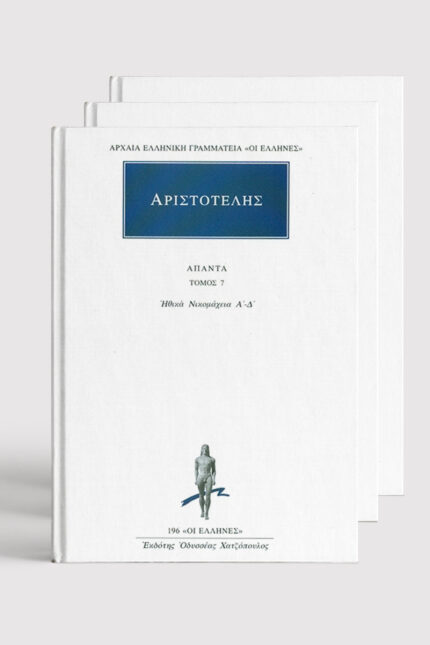
This complete edition of Aristotle's Nicomachean Ethics is published in three volumes, making one of the greatest works of Ancient Greek philosophy accessible to both specialists and modern readers.
Each volume includes:
- The original Ancient Greek text
- A Modern Greek translation on facing pages
- A scholarly introduction
- Detailed commentary and explanatory notes
Designed for careful study as well as enjoyable reading, this edition allows readers to engage directly with Aristotle's language while benefiting from the historical, philosophical, and linguistic insights provided throughout the commentary.
About Aristotle
Aristotle (384–322 BC) was one of the greatest philosophers of Ancient Greece and one of the most influential thinkers in history. A student of Plato and later the teacher of Alexander the Great, he founded the Lyceum in Athens, where he developed a remarkably broad body of work spanning philosophy, ethics, politics, logic, biology, physics, metaphysics, rhetoric, and literary criticism.
Unlike Plato, who often explored ideas through dialogues, Aristotle developed a systematic approach to observation, analysis, and classification that laid the foundations for many modern academic disciplines. His surviving works—including the Nicomachean Ethics, Politics, Metaphysics, Poetics, and the Organon—have shaped intellectual history for more than two millennia.
Today, Aristotle remains one of the world's most studied philosophers, whose ideas continue to inform discussions of ethics, science, education, politics, and the pursuit of human flourishing.