
Journal
Aeschylus and the Birth of Tragic Thought

When later generations think of Greek tragedy, they often think first of Sophocles’ psychological depth or Euripides’ unsettling realism. Aeschylus can appear more remote: his language elevated, his characters monumental, his gods overpowering. Yet it is precisely Aeschylus who invents something genuinely new – not just a dramatic form, but a way of thinking. With Aeschylus, myth ceases to be merely inherited story and becomes moral and political inquiry. Tragic thought is born.
Aeschylus does not abandon myth; he transforms it. He treats inherited tales of gods and heroes as material through which fundamental questions can be asked: What is justice? How does violence reproduce itself? Can divine order coexist with human law? And what does it mean for a community to take responsibility for judgment rather than leaving it to vengeance or fate?
Aeschylus: From Mythic Narrative to Moral Problem
Before Aeschylus, myth explained the world by telling stories about divine action. These stories accounted for origins, rituals, and social norms, but they did not invite sustained ethical interrogation. Events happened because gods willed them, and suffering followed from divine displeasure or ancestral curse. This was the world the Greeks had learned from Homer, their first teacher.
Aeschylus retains this mythic framework, but he introduces something radical: conflict within justice itself. His plays do not simply show the punishment of wrongdoing; they show competing claims to justice colliding. Wrong is answered by wrong, punishment by counter-punishment, until justice becomes indistinguishable from violence.
In this way, myth becomes a problem rather than a solution. The audience is no longer asked merely to witness divine order at work, but to confront its costs and contradictions. Tragedy becomes a space where inherited explanations are put under pressure, much as the Presocratic philosophers were putting mythic accounts of nature under pressure in the same century.
Justice as a Historical Process
Aeschylus’ most profound innovation is his treatment of justice (dikē) as something that develops over time. Justice is not static or immediately transparent. It evolves through suffering, error, and transformation.
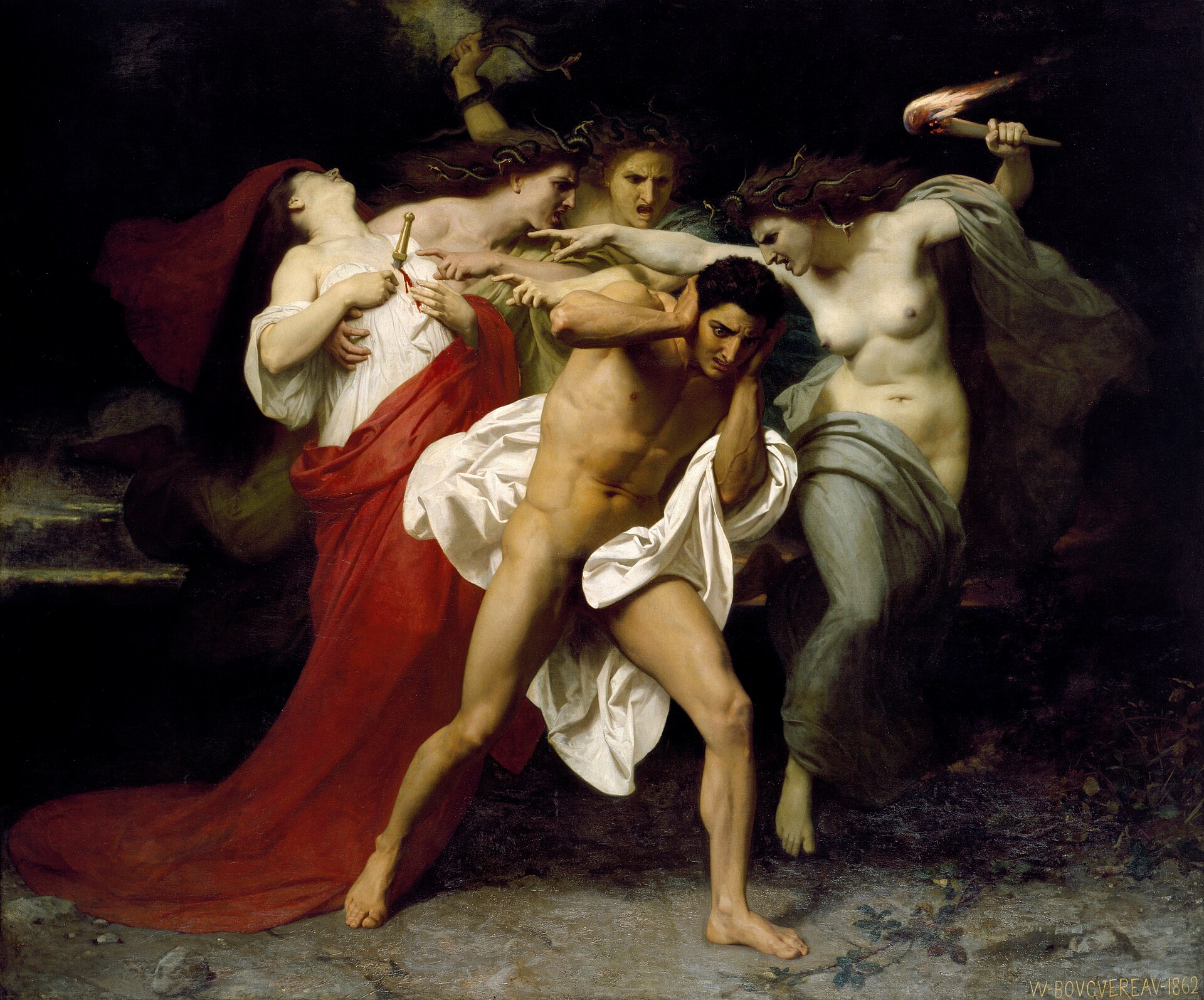
This is most clearly visible in the Oresteia, the only surviving tragic trilogy. The story begins in blood: Agamemnon sacrifices his daughter Iphigenia to wage war, Clytemnestra murders Agamemnon in revenge, Orestes kills Clytemnestra to avenge his father. Each act is justified according to an older logic of retaliation. Each is also a crime.
What Aeschylus exposes is the self-perpetuating nature of vengeance. Every act of justice generates a new injustice. The gods themselves are divided: Apollo commands Orestes to kill; the Furies pursue him for doing so. Divine authority is no longer unified.
Justice, then, cannot remain what it has been. The trilogy’s movement is not toward purification of guilt, but toward a transformation of how justice is conceived. In the final play, Eumenides, judgment is transferred from private vengeance to a public court. Law emerges not by erasing violence, but by containing it.
This is a revolutionary idea. Justice becomes a collective, institutional process rather than a sacred reflex. It is no longer enough that an act be commanded by a god; it must be judged by a community.
Divine Order Under Strain
Aeschylus is often described as the most “religious” of the tragedians, but his religiosity is anything but simple. His gods are powerful, yet they are not morally unambiguous. Zeus, especially, appears as both guarantor of order and source of terror.
In plays like Agamemnon and Prometheus Bound, Zeus’ rule is marked by force. He establishes order by overthrowing previous regimes and punishing resistance. Prometheus, punished for helping humanity, exposes the violence at the heart of divine authority.
Aeschylus does not resolve this tension by rejecting the gods. Instead, he dramatizes the need for divine order to evolve. Zeus himself, in Aeschylus’ vision, learns restraint. Power must be tempered by justice, and justice must be tempered by persuasion.
This transformation is crucial. The gods do not disappear, but they cease to be the sole arbiters of justice. Their authority is redirected into structures that allow human participation. Divine order survives, but in altered form.
The Emergence of Law and the Political Imagination
What distinguishes Aeschylus from later tragedians is the explicitly political dimension of his thought. His tragedies are not merely about individual suffering or ethical dilemmas; they are about the conditions under which a community can exist without destroying itself.
The trial scene in Eumenides is unprecedented in Greek literature. It stages the birth of legal reasoning: argument, counterargument, evidence, and judgment. Athena does not abolish the Furies; she incorporates them into the new order as protectors of the city. Violence is not denied, but transformed.
This is not a naive celebration of law. The verdict is tied, and Athena casts the deciding vote. Law is revealed as contingent, fragile, and dependent on human and divine cooperation. Yet it is also necessary. Without it, the cycle of blood never ends.
In this sense, Aeschylus articulates a political vision suited to a democratic polis. Authority is no longer purely inherited or imposed; it is negotiated. Justice requires institutions, not just gods – the same conviction that would later drive the political speeches of Demosthenes before the Athenian assembly.
Tragic Thought as Collective Reflection
Aeschylean tragedy does not offer comfort. Its choruses are heavy with fear, memory, and dread. Suffering is not redeemed; it instructs. The famous phrase pathei mathos – learning through suffering – captures the essence of tragic thought.
This learning is not private or psychological. It is collective. The audience, gathered as citizens, witnesses the consequences of violence and the necessity of transformation. Tragedy becomes a civic exercise in reflection.
Unlike philosophy, which seeks clarity and definition, tragedy works through tension and irresolution. It does not tell the audience what to think; it forces them to think by confronting them with contradictions they cannot easily escape.
In Aeschylus, this reflective function is inseparable from politics. The emergence of law, the limits of vengeance, and the transformation of divine authority are not abstract themes; they are questions the city must answer to survive.
Why Aeschylus Matters to This Day
Aeschylus matters because he shows how a culture can interrogate its own foundations without abandoning them. He does not reject myth, religion, or tradition. He subjects them to scrutiny from within.
This is the birth of tragic thought: the recognition that justice can be both necessary and violent, that order can emerge from conflict, and that progress does not erase suffering but passes through it.
Later tragedians will refine character, psychology, and realism, as the plays of Euripides show. But Aeschylus establishes the deepest framework: tragedy as a space where inherited narratives become sites of ethical and political inquiry.
The Roots of Tragic Thought and Narration
With Aeschylus, tragedy becomes more than storytelling. It becomes a way of thinking about justice, power, and communal life. Myth is no longer just remembered; it is questioned. Divine order is no longer simply obeyed; it is reimagined. Law emerges not as a given, but as an achievement born from conflict.
In staging these transformations, Aeschylus invents tragic thought itself – a mode of reflection that accepts suffering as unavoidable, justice as fragile, and political order as something that must be continually made and remade.
To read Aeschylus is to witness the moment when myth turns into inquiry, and when the stage becomes a place where a city thinks about its own soul.
Read the Oresteia, Prometheus Bound and the rest of the surviving plays in Aeschylus – Complete Tragedies.
Image: William-Adolphe Bouguereau, Orestes Pursued by the Furies (1862), Chrysler Museum of Art. Public domain, via Wikimedia Commons.