
Journal
Parallel Lives: Why Comparison Teaches Better Than Praise

Plutarch’s Parallel Lives is often read as a gallery of great men. Statesmen, generals, lawmakers, and founders pass before the reader in dignified succession. It is tempting to treat the work as a moral celebration, a collection of exemplary biographies designed to inspire admiration. Yet this way of reading Plutarch misunderstands both his method and his purpose.
Plutarch does not write to produce heroes. He writes to train judgment. His distinctive pairing of Greek and Roman lives is not meant to rank greatness or crown winners. It is meant to sharpen perception. By placing lives side by side, Plutarch forces readers to compare, hesitate, and reflect. Moral insight arises not from praise, but from contrast.
Biography as Moral Inquiry
Plutarch is explicit about his aims. He is not writing history in the strict sense. He does not attempt to narrate every event or reconstruct complex political causality. Instead, he focuses on character, choice, and moral texture. Small actions, casual remarks, and personal habits matter more to him than grand campaigns.
This focus does not make his work superficial. On the contrary, it allows Plutarch to ask a different kind of question. Not what happened, but what kind of person acted, and how.
Biography becomes a form of ethical inquiry. The life is treated as a case study in character under pressure. Virtue and vice are not abstract qualities. They are patterns revealed over time.
Yet Plutarch knows that moral evaluation is difficult. No life is simple. No character is consistent. Praise alone obscures this complexity. Comparison brings it into view.
Why Pairing Matters
The innovation of the Parallel Lives lies in its structure. Each Greek life is paired with a Roman one, followed by a comparison that draws out similarities and differences. These pairings are not arbitrary. They are organized around shared roles, ambitions, or reputations.
A Greek statesman is set beside a Roman general. A lawgiver beside a founder. A charismatic leader beside a disciplined administrator. The reader is invited to notice resemblances, but also divergences.
This structure prevents easy admiration. If one figure appears admirable, the paired life complicates that impression. Virtues appear in different forms. The same trait may produce different outcomes depending on context.
Comparison interrupts moral reflex. It forces the reader to think rather than applaud.
Virtue Without Idealization
Plutarch does not deny virtue. He takes it seriously. Courage, self-control, generosity, and justice are real qualities that shape lives and communities. But he refuses to idealize them.
A courageous man may also be reckless. A disciplined leader may be cruel. A generous patron may crave admiration. By placing two lives side by side, Plutarch shows how the same virtue can coexist with different flaws.
This is especially clear in his treatment of ambition. Many of Plutarch’s subjects are driven by the desire for honor and distinction. In some cases, ambition fuels public service. In others, it corrodes judgment.
Comparison allows Plutarch to explore these variations without turning ambition into either a vice or a virtue in the abstract. Moral evaluation remains contextual and nuanced.
Flaws as Revelations, Not Disqualifications
One of the most striking features of the Parallel Lives is Plutarch’s willingness to dwell on flaws. He does not hide them. He often highlights moments of weakness, anger, vanity, or poor judgment.
These flaws are not included to undermine admiration, but to deepen understanding. A life without error teaches nothing. Moral discernment requires seeing how virtues break down under strain.
By comparing flawed lives, Plutarch shows that failure itself can take different forms. One leader may fall through excess confidence, another through indecision. One may be ruined by indulgence, another by rigidity.
The point is not to condemn, but to discriminate. Moral judgment is sharpened by recognizing patterns rather than issuing verdicts.
Greek and Roman Perspectives
The pairing of Greek and Roman lives also serves a cultural purpose. Plutarch writes as a Greek living under Roman rule. His comparisons do not simply celebrate Rome or defend Greece. They create a dialogue between traditions.
Greek lives often emphasize intellectual subtlety, political debate, and civic complexity. Roman lives often emphasize discipline, order, and institutional continuity. These are not stereotypes, but tendencies shaped by historical conditions.
By setting these traditions side by side, Plutarch avoids cultural superiority. Each produces admirable figures and dangerous ones. Each reveals strengths and limitations.
The reader is invited to learn from both, not to choose between them.
Judgment Rather Than Emulation
Plutarch famously warns that his lives should not be read as blueprints for imitation. Circumstances differ. Characters are unique. Blind emulation is dangerous.
What he offers instead is training in judgment. By observing how different people respond to power, success, failure, and temptation, readers learn to evaluate conduct rather than copy it.
This is why comparison matters so much. Praise encourages imitation. Comparison encourages evaluation. The reader must decide what truly deserves admiration and what merely appears impressive.
This process is demanding. It requires attention, memory, and reflection. But it is also liberating. Moral understanding becomes an active exercise rather than passive admiration.
Contradiction as Moral Reality
One of Plutarch’s deepest insights is that contradiction is not an accident of character, but its substance. People are rarely consistent. They act generously in one moment and selfishly in another. They uphold principles and violate them.
Comparison brings these contradictions into focus. A Greek and a Roman may share a virtue, but express it differently. One may succeed where the other fails. The contrast reveals the fragility of moral identity.
Plutarch does not resolve these tensions. He preserves them. Moral life, he suggests, is not about achieving purity, but about navigating complexity.
Reading as Ethical Practice
To read the Parallel Lives well is to practice judgment. The reader must hold multiple examples in mind, weigh motives, assess consequences, and resist easy conclusions.
This is why the comparisons at the end of each pair matter. They do not dictate interpretation. They model it. Plutarch shows how to compare without flattening difference or forcing conclusions.
The reader is invited into the same activity. Moral understanding becomes collaborative rather than authoritative.
Why This Still Matters
In modern culture, public figures are often treated as either heroes or villains. Admiration and condemnation replace judgment. Complexity is flattened for the sake of clarity.
Plutarch offers an alternative. He teaches us to look closely, to compare, and to hesitate. Moral insight emerges not from certainty, but from sustained attention to difference.
This approach is especially valuable in a world saturated with praise. Comparison resists idolization. It exposes the cost of greatness and the ambiguity of success.
The Art of Comparison
Plutarch’s Parallel Lives is not a monument to greatness. It is a school of judgment. By placing lives side by side, Plutarch trains readers to see virtues and flaws together, without simplification or reverence.
Comparison teaches better than praise because it demands thought. It forces readers to evaluate rather than admire, to discriminate rather than applaud.
In this way, Plutarch turns biography into moral education. Not by telling us whom to praise, but by teaching us how to judge.
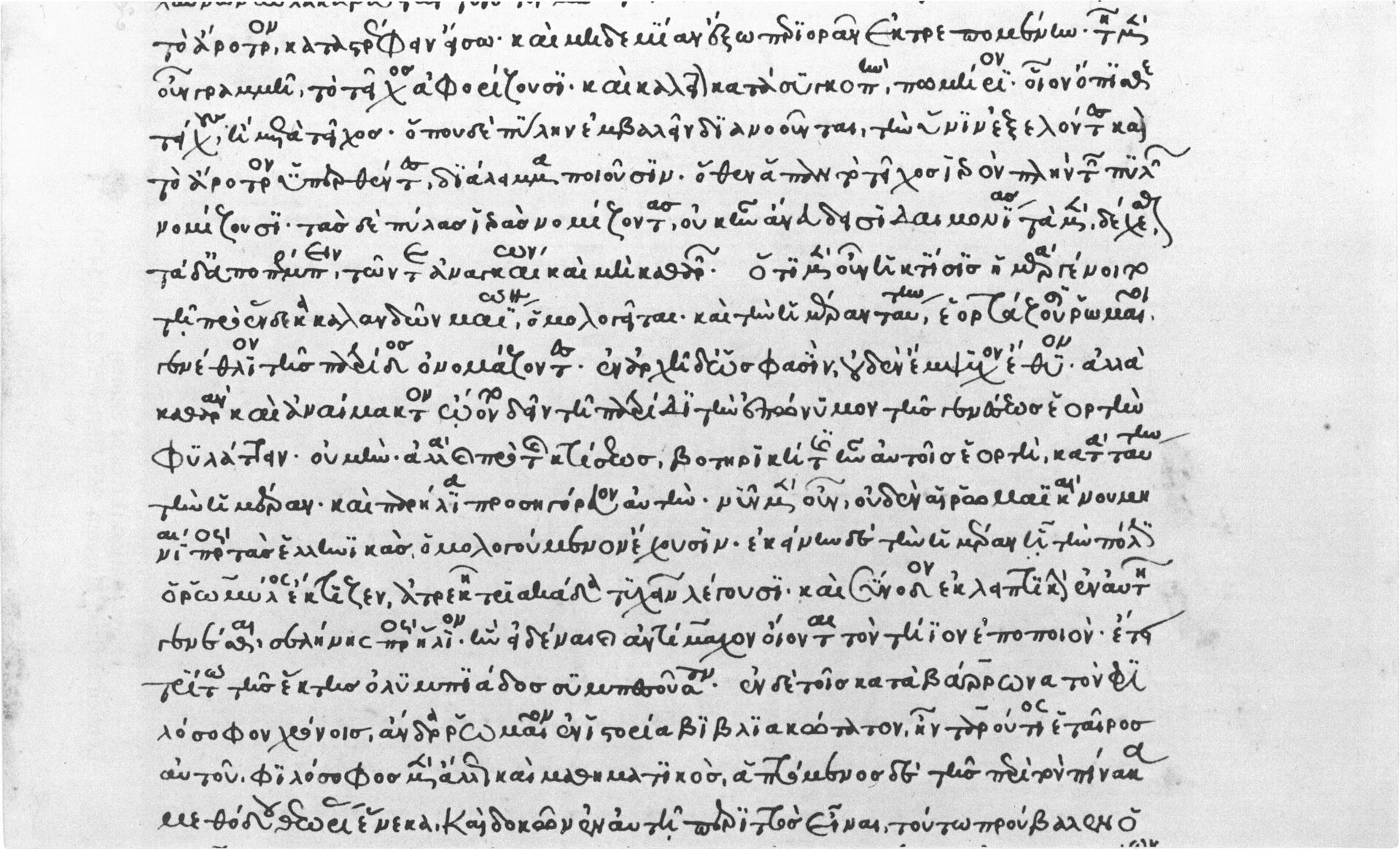
Image: Plutarch, Parallel Lives, Oxford, Bodleian Library, MS. Canonici Greek 93. Public domain, via Wikimedia Commons.