
Journal
How Ancient Greek Historians Invented History as a Discipline

History did not always exist as a discipline. For much of human culture, the past was preserved through myth, genealogy, epic poetry, and collective memory. Stories about origins explained who a people were, where they came from, and why their customs mattered. These narratives were meaningful, but they were not investigative. They did not ask whether an event really happened in the way it was told, nor did they seek to weigh competing accounts or explain causes beyond divine intention.
Ancient Greek historians changed this. Over the course of the fifth and fourth centuries BCE, Greek writers transformed memory into inquiry and storytelling into analysis. History became a distinct intellectual practice, grounded in investigation, evidence, causality, and judgment. This transformation did not produce modern historiography overnight, but it laid the foundations on which all later historical method would build.
Ancient Greek Historians: From Myth to Inquiry
The crucial shift begins with the idea of historia itself. In Greek, the word does not originally mean “history” in the modern sense. It means inquiry, investigation, the act of finding out. To write history is not simply to repeat what has been heard, but to ask questions about it.
Herodotus famously opens his work by presenting it as an inquiry into human deeds, undertaken so that great actions will not fade into obscurity and so that their causes will be understood. This emphasis on causes marks a decisive break from myth. Events are no longer explained solely by divine will or fate. Human decisions, cultural practices, and political structures enter the explanatory frame.
Myth does not disappear. Herodotus reports traditional stories, divine interventions, and oracles. But he treats them differently. He compares versions, expresses doubt, and sometimes suspends judgment. The historian’s task is no longer to preserve sacred narrative intact, but to examine it critically.
This attitude creates a new relationship to the past. The past becomes something that can be questioned.
Evidence and the Authority of Observation
Greek historians developed new standards of credibility. They distinguish between what they have seen, what they have heard from witnesses, and what is merely reported by tradition. Autopsy, direct observation, becomes a privileged source of knowledge.
Herodotus frequently notes when he has seen something himself, such as monuments, landscapes, or customs. When he relies on others, he often names his informants or signals uncertainty. This transparency about sources is itself a methodological innovation.
Thucydides pushes this standard further. Writing about the Peloponnesian War, he rejects mythic embellishment and popular rumor. He emphasizes careful verification, cross-checking testimony, and critical evaluation of speeches and reports. He acknowledges the difficulty of knowing the truth, especially during wartime, but insists that rigor is both possible and necessary.
Evidence, for Greek historians, is not limited to documents. It includes observation, testimony, geography, and material remains. What matters is not the form of the evidence, but the historian’s judgment in weighing it.
Causality Beyond the Gods
Another defining feature of Greek historiography is its approach to causation. Earlier narratives explained events through divine favor or punishment. Greek historians do not deny the gods outright, but they reduce their explanatory monopoly.
Thucydides famously excludes divine causation almost entirely. He explains the Peloponnesian War through fear, interest, and power. His account of the war’s origins distinguishes between immediate causes and deeper structural ones. This analytical layering of causation is unprecedented.
Herodotus, though more open to divine influence, also emphasizes human motives. Pride, revenge, ambition, and miscalculation drive events forward. The gods may sanction outcomes, but humans generate the conditions.
This shift matters because it makes history intelligible without making it deterministic. Events follow from choices and circumstances, not from inscrutable fate. The past becomes something that can be understood and, potentially, learned from.
Chronology and the Ordering of Time
Greek historians also invent new ways of organizing time. Mythic narratives often float in an undefined past. Greek historiography imposes sequence, duration, and synchronization.
Events are placed in relation to one another. Wars unfold year by year. Causes precede effects. This temporal ordering allows for comparison and analysis. One can ask not only what happened, but what happened first, what followed, and how long processes took to unfold.
Thucydides’ strict chronological structure reflects his belief that understanding depends on temporal clarity. Even when his narrative is complex, its underlying logic is linear. Time becomes a framework for explanation rather than a backdrop for storytelling.
This temporal discipline is essential to history as a method. Without it, causality dissolves into anecdote.
Judgment and Interpretation
Greek historians do not merely collect facts. They interpret them. They judge actions, policies, and character.
This judgment is not moralizing in the poetic sense, but analytical. Thucydides assesses the consequences of decisions. He shows how arrogance leads to overreach, how fear distorts judgment, how rhetoric manipulates crowds. His history is not a sermon, but it is not neutral.
Herodotus, too, evaluates. He contrasts customs, highlights excess, and reflects on the instability of fortune. His work suggests that understanding the past requires sensitivity to human limitation and error.
This interpretive dimension distinguishes history from chronicle. A list of events is not history. History requires selection, emphasis, and explanation. Greek historians accept this responsibility and make their criteria visible.
Shaping History as a Public Intellectual Practice
Greek historiography emerges in a culture of public debate. Historians write for audiences capable of disagreement. Their works implicitly invite critique.
This is why they explain their methods. Thucydides tells the reader how he handled speeches and evidence. Herodotus tells the reader when he doubts a story. These methodological reflections are not digressions. They are part of the argument that history is a rational enterprise.
History becomes a discipline because it develops norms. Inquiry must be careful. Evidence must be evaluated. Causes must be argued. Judgments must be defensible. These norms are not enforced by institutions, but by intellectual culture.
Limits and Legacies
Greek historiography is not modern historiography. It excludes many voices. Women, slaves, and non-elites appear only indirectly. Quantitative data is rare. Economic structures are underdeveloped as analytical categories.
Yet the core principles endure. The idea that the past can be investigated. That accounts can be compared and evaluated. That explanation matters more than mere narration. That history involves judgment.
These principles shape Roman historiography and, much later, early modern historical writing. Even when methods change, the Greek invention of history as inquiry remains foundational.
Why This Invention Matters
By inventing history as a discipline, Greek historians changed how humans relate to their past. The past became something to be understood rather than revered, explained rather than repeated.
This shift has ethical and political consequences. If history can be analyzed, then power can be questioned. If causes can be traced, then responsibility can be assigned. History becomes a resource for reflection rather than a monument to tradition.
Modern historical method, with its archives, theories, and debates, is far more complex than anything the Greeks imagined. But its basic orientation is the same. It treats the past as intelligible, contestable, and meaningful.
The Power of Ancient Greek Historians
Ancient Greek historians did more than record events. They invented history as an intellectual practice. By grounding their work in inquiry, evidence, causality, and judgment, they transformed memory into analysis.
This invention did not produce certainty. It produced responsibility. To write history is to decide what matters, how it connects, and why it should be understood.
That responsibility remains with us. Every time we ask not just what happened, but how and why, we are working within a tradition first shaped by Greek historians who taught the world how to think about its past.
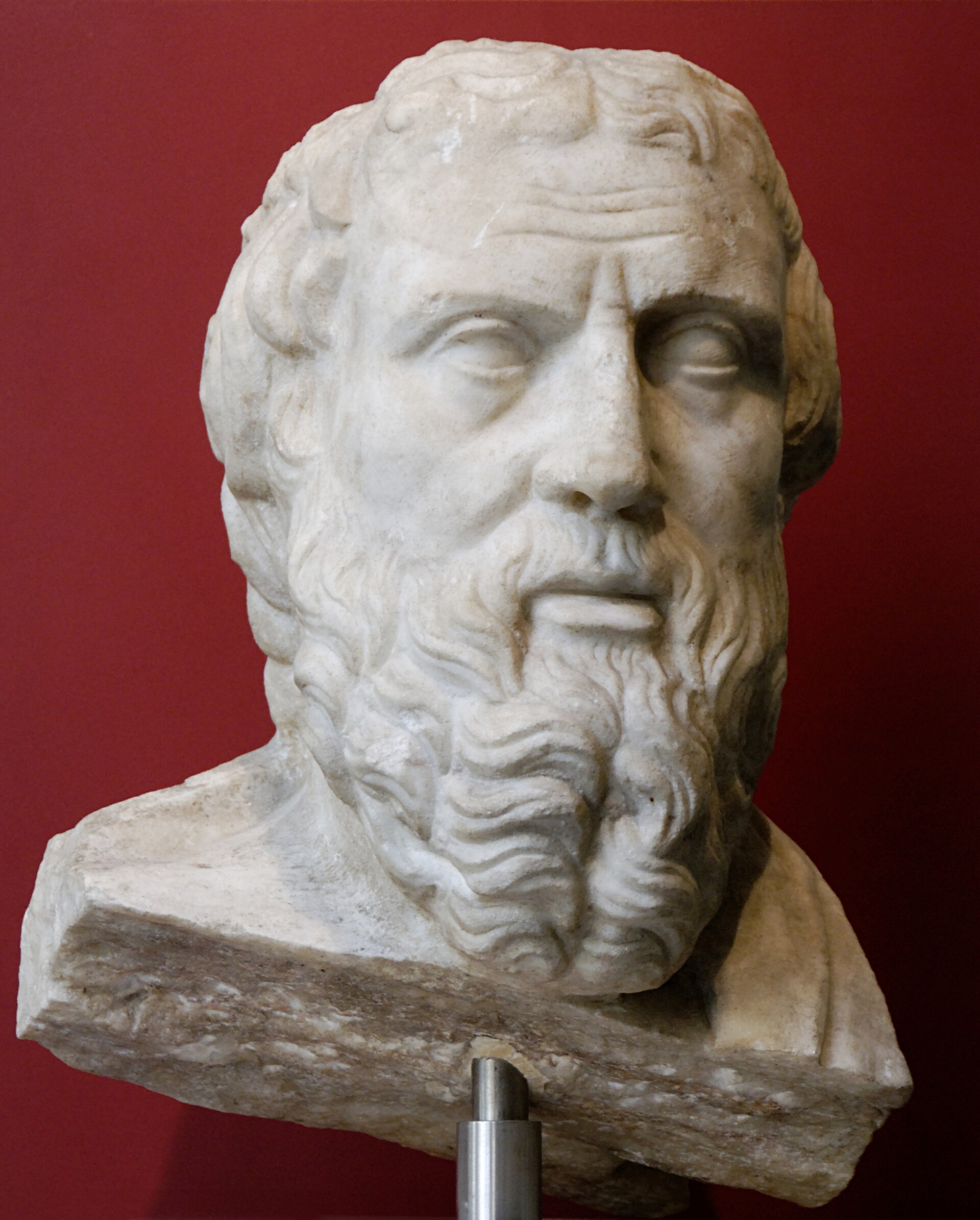
Image: Bust of Herodotus, Palazzo Massimo alle Terme, Rome. Photo: Marie-Lan Nguyen (2009). Public domain, via Wikimedia Commons.